Reducing the output torque ripple of switching reluctance motors using a fuzzy logic system
502 viewsDOI:
https://doi.org/10.54939/1859-1043.j.mst.208.2025.3-10Keywords:
Switching reluctance motors; Fuzzy logic system; Torque ripple reduction; Optimization, Takagi-Sugeno fuzzy model.Abstract
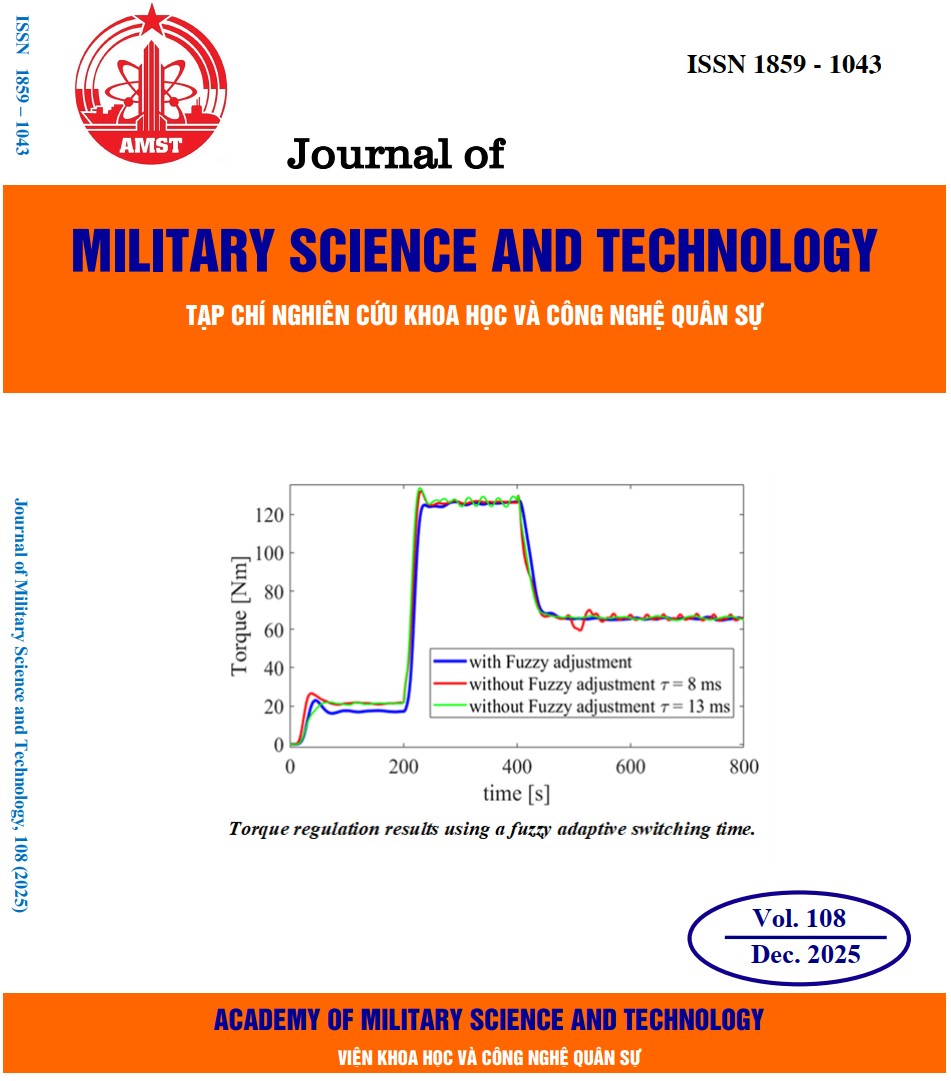
Torque control for the Switched Reluctance Motor (SRM) is always a complex problem because continuous switching between phases is required during operation. This inherent characteristic often causes the SRM's torque profile to fluctuate significantly [1]. In recent years, researchers have endeavored to investigate control methods aimed at improving the torque characteristics of the SRM. These methods have relied on experimental approaches to select appropriate switching times (or switching angles) [2-4]. In a previous paper, we proposed a data table for selecting the switching time based on the reference speed [14]. To enhance the effectiveness of the proposed solution, in this paper, a Fuzzy Logic System (FLS) is constructed to automate the process of selecting the switching time for the SRM. The FLS is built upon the Takagi-Sugeno (TS) fuzzy model. The fuzzy inference system is implemented using the SUMPROD principle, and defuzzification is performed using the Center of Gravity (CoG) method. The TS fuzzy system is trained using the Steepest Gradient method. The research results will be analyzed through digital simulation.
References
[1]. Feng, Liyun, et al., “Optimal torque sharing function control for switched reluctance motors based on active disturbance rejection controller”, IEEE/ASME Transactions on Mechatronics, Vol. 28, No. 5, pp. 2600–2608, (2023). DOI: https://doi.org/10.1109/TMECH.2023.3240986
[2]. Ahmad, Syed Shahjahan et al., “Predictive current control of switched reluctance machine for accurate current tracking to enhance torque performance”, IEEE Transactions on Industry Applications, Vol. 60, No. 1, pp. 1837–1848, (2023). DOI: https://doi.org/10.1109/TIA.2023.3325306
[3]. Li, Haoding et al., “An improved torque sharing function for torque ripple reduction in switched reluctance machines”, IEEE Transactions on Power Electronics, Vol. 34, No. 2, pp. 1635–1644, (2018). DOI: https://doi.org/10.1109/TPEL.2018.2835773
[4]. Chithrabhanu, Arun et al., “Quantification of noise benefits in torque control strategies of SRM drives”, IEEE Transactions on Energy Conversion, Vol. 38, No. 1, pp. 585–598, (2022). DOI: https://doi.org/10.1109/TEC.2022.3201325
[5]. Sun, Xiaodong et al., “Torque ripple reduction of SRM drive using improved direct torque control with sliding mode controller and observer”, IEEE Transactions on Industrial Electronics, Vol. 68, No. 10, pp. 9334–9345, (2010). DOI: https://doi.org/10.1109/TIE.2020.3020026
[6]. Vo Thi, Cam Thuy et al., “Stabilisation for multi-phase switched reluctance machine by a novel synchronisation of harmonic eradication mechanisms without resistance measurement and input-output relationships”, International Journal of Control, pp. 1–19, (2025). DOI: https://doi.org/10.1080/00207179.2024.2447060
[7]. Yu, Z. et al., “Continuous rotor position estimation for flux modulated doubly salient reluctance motor drives based on back EMF harmonics”, IEEE Transactions on Industrial Electronics, Vol. 70, No. 6, pp. 5604–5614, (2023). DOI: https://doi.org/10.1109/TIE.2022.3196378
[8]. Azer, P. et al., “Model-based spatial harmonics vector compensation method for three-phase mutually coupled switched reluctance machine with sinusoidal current excitation”, IEEE Open Journal of Power Electronics, No. 1, pp. 216–226, (2020). DOI: https://doi.org/10.1109/OJPEL.2020.3004853
[9]. Das, J. C., “Power system harmonics and passive filter design”, IEEE Press Series on Power Engineering, IEEE Press and Wiley, (2015). DOI: https://doi.org/10.1002/9781118887059
[10]. Vo Thi, Cam Thuy et al., “Dynamic surface control for the switched reluctance motor”, International Conference on System Science and Engineering (ICSSE), (2023).
[11]. Sreeram, Krishnamoorthy et al., “Modified switching control of SRM drives for electric vehicle application with torque ripple reduction”, International Journal of Power Electronics and Drive Systems, Vol. 15, No. 1, pp. 147–159, (2024). DOI: https://doi.org/10.11591/ijpeds.v15.i1.pp147-159
[12]. Qiao, W. et al., “Optimization Design and Control of Six-Phase Switched Reluctance Motor with Decoupling Winding Connections”, Applied Sciences, Vol. 12, No. 17, pp. 8801–8822, (2024). DOI: https://doi.org/10.3390/app12178801
[13]. Vinter, R. B., “Optimal control”, Boston: Birkhäuser, Vol. 2, No. 1, (2010). DOI: https://doi.org/10.1007/978-0-8176-8086-2_1
[14]. Vo Thi, Cam Thuy; Do Manh Dung; Nguyen Duc Khoat; Phan Xuan Minh, “An enhancement of output torque ripple of the switching reluctance motor based on appropriate time switching selection”, Journal of Mining and Earth Sciences, No. 66, Issue 1, pp. 90–97, (2025). DOI: https://doi.org/10.46326/JMES.2025.66(1).09